Today we started to pick the Cabernet Sauvignon. This morning its sugar tested 25 degrees balling. The Petit Verdot and Merlot is still not ready and tested 23.0 and 23.6 degrees balling.
After picking we will cool the Cabernet down to 5 degrees Celsius. Two reason for this. The grapes usually will measure about the same temperature as the air or micro climate around the berries. When this happens in the Calitzdorp that temperature can be around 25 - 35 degrees Celsius. The fermentation will go quickly and put a lot of stress on my allready shaky cooling system. I also feel that a longer fermentation period under less stressful enviroment will lead to a better wine. In winemaking terms we are talking about a cold maceration before the fermentation.
The Merlot and Petit will probably be ready next week. And as with most things they will be probably be ready the same day.
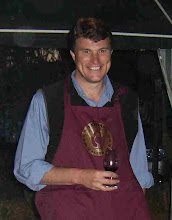
Ronnie van der Walt one of the guys of last years wine school flew in on Saturday. He is planning to make a Merlot based blend. Ronnie previously also involved in restaurant business and an artist by training, works this year with Withoek Cellar to also master the art of winemaking. He allready had to take the samples for sugars and were busy cleaning and preparing the cellar for the grapes today.
We will report on Ronnie's status during this years harvest.
Tuesday, February 22, 2011


Monday, February 14, 2011
Final Countdown
The 2010/11 season now slowly going into the final phases. Our peach harvest was good and even though the prices weren't the best they still paid their dues.
As with our plums we went straight to the market with the table grapes. The prices weren't that high but we can't really complain. Because of our dry weather in the beginning we had excellent quality fruit in December but with the continuos short spells of rain combinating with humid warm days the fungi attacked big time. The table grapes is usually thinner and thus the fungi get easier hold on them. Further they are mostly planted on strong rootstocks with big vigourous growth which contributes to good fungi growth climates within the canopy.
Even though the weather didn't play along our harvest was good. But we are now reaching a phase in which we started deliver it to the Calitzdorp Cellar. This week we actually starting to do the harvest all grapes very seriously.
Our red wine cultivars sugars are still very low. I think the 40mm of thunder storm contributed more than we think. The table grapes sugar funny enough tends to a higher value than previous seasons.
Our wine making weekend seems to change from the coming weekend to the following weekend because of the low sugars. The quality of the grapes really looks good and I think this might be a good season.
As with our plums we went straight to the market with the table grapes. The prices weren't that high but we can't really complain. Because of our dry weather in the beginning we had excellent quality fruit in December but with the continuos short spells of rain combinating with humid warm days the fungi attacked big time. The table grapes is usually thinner and thus the fungi get easier hold on them. Further they are mostly planted on strong rootstocks with big vigourous growth which contributes to good fungi growth climates within the canopy.
Even though the weather didn't play along our harvest was good. But we are now reaching a phase in which we started deliver it to the Calitzdorp Cellar. This week we actually starting to do the harvest all grapes very seriously.
Our red wine cultivars sugars are still very low. I think the 40mm of thunder storm contributed more than we think. The table grapes sugar funny enough tends to a higher value than previous seasons.
Our wine making weekend seems to change from the coming weekend to the following weekend because of the low sugars. The quality of the grapes really looks good and I think this might be a good season.
Tuesday, January 18, 2011
School of Wine
Trying to predict the ripening process of grapes especially if you want to time it to perfection is usually the wrong way of producing great wines. But sometimes situations calls for a little daring. Selma contacted me the other day for another Kairos wine weekend. And it seems after a bottle or what of wine that the time was put on the third weekend of February. With peaches and early grapes ripening 7 days earlier it seems to be a good guess that we might have a little earlier ripening.
The School of Wine - Kairos version - is a weekend in which a few people get around and try and do the whole process of wine making in a weekend. Now a good winemaker or informed wine drinker might tell you quickly this is impossible. Well it is.
This weekend will contain a tasting and welcoming braai in the House of Straw at Zelma's country estate. The tasting will be an introduction into wine styles of the region - Calitzdorp. It will be very informal.
The Saturday is started with a grape pick. After last years heat wave we decided to pick the bulk of the grapes earlier the week and cold store it. This will be followed by Zelma's country breakfast. Something to strengthen the muscles for the day to follow.
The first real action in winemaking is the crushing of the grapes. After which we must inoculate it with the yeast. Do the necessary additions. This will all be shown and the more confident can actually get the chance of doing it themselves. The midday program consist of punch throughs and later pressings. Doing the necessary tasting of the juice and maturing wine will also be part of the midday program.
Towards the end of the day we will be doing a pressing. Yes here we will need all the muscle we can get. The press is an 60 year old basket press.
The Saturday evening will be a quiet one with a wine movie.
The Sunday morning another pressing. This time the grapes harvested the previous day - Muscadel will be pressed and fortified. This will be the wine of the year for the students. Everyone will receive after bottling which take place later the year three bottles of the product as proof of their total commitment to producing quality wine.
The weekend will end with a brunch at Selma's.
If your are interested do contact the lady of the hour - Selma at 0825765855 and join us.
The wine which you will also be part of making will be a Cabernet Sauvignon, Merlot and Petit Verdot. Withoek are planning to make a Bordeaux blend.
The School of Wine - Kairos version - is a weekend in which a few people get around and try and do the whole process of wine making in a weekend. Now a good winemaker or informed wine drinker might tell you quickly this is impossible. Well it is.
This weekend will contain a tasting and welcoming braai in the House of Straw at Zelma's country estate. The tasting will be an introduction into wine styles of the region - Calitzdorp. It will be very informal.
The Saturday is started with a grape pick. After last years heat wave we decided to pick the bulk of the grapes earlier the week and cold store it. This will be followed by Zelma's country breakfast. Something to strengthen the muscles for the day to follow.
The first real action in winemaking is the crushing of the grapes. After which we must inoculate it with the yeast. Do the necessary additions. This will all be shown and the more confident can actually get the chance of doing it themselves. The midday program consist of punch throughs and later pressings. Doing the necessary tasting of the juice and maturing wine will also be part of the midday program.
Towards the end of the day we will be doing a pressing. Yes here we will need all the muscle we can get. The press is an 60 year old basket press.
The Saturday evening will be a quiet one with a wine movie.
The Sunday morning another pressing. This time the grapes harvested the previous day - Muscadel will be pressed and fortified. This will be the wine of the year for the students. Everyone will receive after bottling which take place later the year three bottles of the product as proof of their total commitment to producing quality wine.
The weekend will end with a brunch at Selma's.
If your are interested do contact the lady of the hour - Selma at 0825765855 and join us.
The wine which you will also be part of making will be a Cabernet Sauvignon, Merlot and Petit Verdot. Withoek are planning to make a Bordeaux blend.
Monday, January 3, 2011
2011!!
For Withoek Boerdery the new year arrived silently. Because of the smaller apricot harvest we had a very quiet start to the year. We actually had a bit of spare time to clean up the farm and do some very much needed vineyard work.
Our young vines needed to be trained. We removed the extra young shoots and only the strongest survive. This strong shoot was also cut at the cordon wire and the top three buds left. From those three buds we will choose later the season the two strongest for the the cordons of the vine. The rest is all removed to limit the competition. In the old days this process will only take place after a years growth but with correct irrigation and fertilization we get enough growth to train it very much sooner. This means also sooner harvest and thus more economical vineyard.
The apricots will soon go through the summer pruning. This is needed to initiate new growth and wood. Keeps your trees healthier and more consistant in production.
We also look into the possible grafting of some of our plum trees to another cultivar. This process involves the cut down of the trees to creat new shoots and the grafting on this new shoots. I have personally never done this and looking forward to the experience.
The grape harvest looks good and we just hope the weather plays in our favour. It can rain but must just clear up quickly so that we don't get a wet humid climate which will promote fungi growth.
Our young vines needed to be trained. We removed the extra young shoots and only the strongest survive. This strong shoot was also cut at the cordon wire and the top three buds left. From those three buds we will choose later the season the two strongest for the the cordons of the vine. The rest is all removed to limit the competition. In the old days this process will only take place after a years growth but with correct irrigation and fertilization we get enough growth to train it very much sooner. This means also sooner harvest and thus more economical vineyard.
The apricots will soon go through the summer pruning. This is needed to initiate new growth and wood. Keeps your trees healthier and more consistant in production.
We also look into the possible grafting of some of our plum trees to another cultivar. This process involves the cut down of the trees to creat new shoots and the grafting on this new shoots. I have personally never done this and looking forward to the experience.
The grape harvest looks good and we just hope the weather plays in our favour. It can rain but must just clear up quickly so that we don't get a wet humid climate which will promote fungi growth.
Monday, December 13, 2010
The History of 2010 Apricots
Yes it really came with a bang and our harvest of the apricots is finished. Withoeks production of apricots is much lower than last season. The contributing factors is because of the frost in August - bloom time.
Some of the lower orchards didn't even reach a tonne per ha. After everything added and done our harvest seems to be down by about 40%.
The dried fruit prices also gone south and so we decided to cut our losses and dry much less. The quality of the fruit which we did dry was much better than previous seasons and it shows in the dried fruit quality. The colour is really good and because of the early finish we could do the right thing and get it of the stellations much quicker which means higher water content in the fruit - thus it would be heavier and fuller. Much more attractive product.
Because of the dry weather our vineyards is very healthy and we sprayed this week which might be our last one. Our young vines need some attention and we plan to get to it in the next week or two.
The peaches we are also selling to the canner because of the world wide overproduction of dried peaches. We are lucky when one of the canners closed their depot in Calitzdorp another opened one. The prices is also lower than last year but atleast we do have a buyer. The peach size is a bit disappointing but could be contributed to micro element shortages. I picked it way to late and are spraying like mad to get it back but I think I might have lost this season fruit. In Calitzdorp we usually don't spray to much of the micro element but with peaches you must actually be very aware of it. The peach is a plant which easily shows such shortages and or toxic highs of micro elements.
Some of the lower orchards didn't even reach a tonne per ha. After everything added and done our harvest seems to be down by about 40%.
The dried fruit prices also gone south and so we decided to cut our losses and dry much less. The quality of the fruit which we did dry was much better than previous seasons and it shows in the dried fruit quality. The colour is really good and because of the early finish we could do the right thing and get it of the stellations much quicker which means higher water content in the fruit - thus it would be heavier and fuller. Much more attractive product.
Because of the dry weather our vineyards is very healthy and we sprayed this week which might be our last one. Our young vines need some attention and we plan to get to it in the next week or two.
The peaches we are also selling to the canner because of the world wide overproduction of dried peaches. We are lucky when one of the canners closed their depot in Calitzdorp another opened one. The prices is also lower than last year but atleast we do have a buyer. The peach size is a bit disappointing but could be contributed to micro element shortages. I picked it way to late and are spraying like mad to get it back but I think I might have lost this season fruit. In Calitzdorp we usually don't spray to much of the micro element but with peaches you must actually be very aware of it. The peach is a plant which easily shows such shortages and or toxic highs of micro elements.
Sunday, November 28, 2010
Apricots!!
This time of year it usually the only time you might get a traffic jam in Calitzdorp. With all the farmers trying to get the apricots down and to the canners it really is a rush time.
At Withoek we haven't finish yet. There is still block we must pick and the time doesn't seem to be enough. We finished with one canner Langeberg & Ashton last week. Rhodes Fruit Farms still need a small amount of tonnes to finish that contract and then the last is Boland Pulp.
While we are picking the apricots the other things like spray program for the vineyards and training of the younger vines fall behind. Every week I catch myself saying next week. Well next it will be.
At Withoek we haven't finish yet. There is still block we must pick and the time doesn't seem to be enough. We finished with one canner Langeberg & Ashton last week. Rhodes Fruit Farms still need a small amount of tonnes to finish that contract and then the last is Boland Pulp.
While we are picking the apricots the other things like spray program for the vineyards and training of the younger vines fall behind. Every week I catch myself saying next week. Well next it will be.
Tuesday, November 16, 2010
First Pickings
Withoek started to pick fruit last week. So far the fresh market prices were good and quality and size of fruit also. Withoek's Super Gold was finished harvest this week and the plums look as if they will also be gone by the end of the week.
I looked today at the Bullida orchards and got a bit of a scare. The fruit size is good but it seems that the fruit is ripening at a alarming rate. So we are going to start picking the Bullida's allready tomorrow. The bullida is the apricot mostly found in the Calitzdorp region and is used for drying and canning. You can also use it for making jam.
The next variety which is also a packing variety will be the Palsteyn. It is a beautiful apricot but unfortunately can only be used for fresh use. It's jam will turn dark soon after making and pitch black after a month. Nothing wrong with the taste though.
The prices of the dried fruit has gone down dramatically. The push in the markets seems to force us the producers into larger fruit.
It looks like we at Withoek will in future have to start spraying to get still larger fruit.
We are hoping also to plant a new type of Plum / Apricot cultivar which is marketed as a fruit for drying. SAD is very excited about this new product. We will plant about a half a hectare to just see how it grows and how the fruit reacts to our enviroment.
I looked today at the Bullida orchards and got a bit of a scare. The fruit size is good but it seems that the fruit is ripening at a alarming rate. So we are going to start picking the Bullida's allready tomorrow. The bullida is the apricot mostly found in the Calitzdorp region and is used for drying and canning. You can also use it for making jam.
The next variety which is also a packing variety will be the Palsteyn. It is a beautiful apricot but unfortunately can only be used for fresh use. It's jam will turn dark soon after making and pitch black after a month. Nothing wrong with the taste though.
The prices of the dried fruit has gone down dramatically. The push in the markets seems to force us the producers into larger fruit.
It looks like we at Withoek will in future have to start spraying to get still larger fruit.
We are hoping also to plant a new type of Plum / Apricot cultivar which is marketed as a fruit for drying. SAD is very excited about this new product. We will plant about a half a hectare to just see how it grows and how the fruit reacts to our enviroment.
Subscribe to:
Posts (Atom)